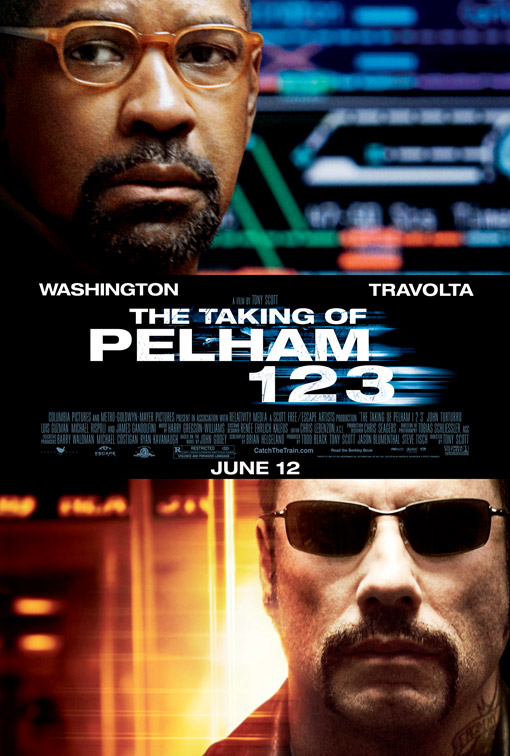
Walter Garber is a decent, good-hearted, flawed individual. As an MTA dispatcher, he toils away in a daily routine that lacks glitz and glamour. There is nothing extraordinary about Walter Garber's life. When he arrives at work on a seemingly typical New York City day, however, he is put in an extraordinary situation. A group of aggravated men have hijacked a subway, holding the passengers on the train hostage. The leader of the hijackers, a man who goes mysteriously by the name of Ryder, demands to talk to Walter Garber. Ryder wants no hostage negotiator or policeman; he simply wants to communicate solely with Mr. Garber. Ryder tells Garber that he wants $10 million in his hands in one hour. If the money does not arrive by the designated time, hostages will be killed. Thus, the burden of preserving human life is placed on the shoulders of Walter Garber. It is Garber's job to guard against disaster.
This is the premise of Tony Scott's "The Taking of Pelham 1 2 3", an update of the 1974 film by the same name. "The Taking of Pelham 1 2 3" is a satisfying thriller that provides moments of genuine suspense. The acting is first-rate, and the screenplay by Brian Helgeland ("L.A. Confidential"; "Mystic River") is taut and intelligent. However, while I do recommend this film, the shaky direction of Tony Scott is almost enough of a distraction to cause me to rescind my recommendation. Tony Scott is known for his hectic, dizzying style behind the camera, and his trickery has worked well before in "Enemy of the State", "Man on Fire", and "Domino". The heedless personality of those films warranted Scott's reckless energy. "The Taking of Pelham 1 2 3", on the other hand, does not require such gimmickry.
At its core, "The Taking of Pelham 1 2 3" is a character study of a working class man struggling to prevent tragedy. This material deserves a measured director, one who places all the focus on the story. Yet Tony Scott, for some mystifying reason, finds it necessary to bombard the screen with a myriad of nearly incomprehensible images. The camera shakes so frequently, it can be difficult for the viewer to form any kind of an emotional attachment with the film. The result of Tony Scott's direction is almost catastrophic. Fortunately, the strong acting, and one brilliant performance in particular, is enough to salvage the movie.
John Travolta is one of the nicest men around, but he makes for a convincing villain here. Travolta's character oozes insanity and insecurity, and Travolta gives a performance that perfectly captures the essence of his character's twisted psychosis. The supporting work is extremely effective as well. The always reliable John Turturro and James Gandolfini shine in supporting roles that are crucial to the success of the picture. However, there is one performance that makes this movie, and that performance belongs to the great Denzel Washington. Washington is spectacular as Walter Garber, and he creates a character on a completely human level to whom we can all relate. The audience forms an emotional bond with Walter Garber, and this is all due to the superb work of Mr. Washington. For Denzel Washington, "The Taking of Pelham 1 2 3" is a minor entry in a long and accomplished filmography, but Washington reminds us once again why he is one of the finest actors in the world.
I recommend "The Taking of Pelham 1 2 3", for there is simply too much skill on display for me to do otherwise. But this premise has the potential of greatness, potential that is not fully realized by director Tony Scott. Scott is a talented filmmaker who has impressed me with his skill behind the camera numerous times in the past. After viewing this film, though, I hope he learns a valuable lesson. Sometimes it's best to just let the story do all the talking.

No comments:
Post a Comment