Wednesday, April 20, 2011

Living Vicariously Through the Canine: "Best in Show"


This is part of a recurring series in which I review some of my all-time favorite movies.


Let me commence this review with a personal admission: I am not a dog lover. I like the idea of dogs in theory, but when I am in their presence, I dissolve into a nervous wreck. There is just something about their relentlessly upbeat energy that I mistake for threatening aggression. My irrational fear of dogs is one of my many eccentricities, and that is why I relate so closely to the wacky cast of characters in Christopher Guest's Best in Show. Unlike me, the group of neurotic charmers in Best in Show have an unabashed love for all things canine-related. They live, breathe, and bleed dog. To say that these people treat their dogs like their children is an understatement. But you see, I understand their neurosis. We are all in one way or another eccentric, and that is why the movies of Christopher Guest are always so hysterically funny and endearing, all at the same time. Sure, Christopher Guest has a blast poking fun at the dog show extravaganzas and all of the people who partake in the spectacle of dog shows, but his comic aim is never mean-spirited. We laugh at the weirdness of the characters in Best in Show, but only because that weirdness is so jarringly human and sweet. The filmmakers behind the cruelly unfunny Scary Movie franchise should take note: It is possible to make a hilarious spoof without tearing people down in the process.


Guest is the King of Mockumentary, and he is responsible for some of the greatest comedies ever made. Every one of his films (A Mighty Wind and Waiting for Guffman to name a couple) are brilliant delights. Best in Show, though, is his best. The laughs come faster than a Usain Bolt sprint. The aforementioned cast of characters are portrayed by an all-star cavalcade of Chris Guest regulars. Catherine O'Hara is a promiscuous owner of a Norwich terrier named Winky. O'Hara's husband is played by Eugene Levy (who co-wrote the flawless screenplay with Guest). Levy's performance as a socially awkward, loyal husband who literally has two left feet is simply priceless. O'Hara and Levy have a tremendous rapport that produces enormous laughs. The same can be said of Parker Posey and Michael Hitchcock, who gleefully portray a pompous rich couple worried that their dog has been emotionally scarred after the dog witnessed them having sex. Michael McKean and John Michael Higgins are also magnificent as the gay couple who are proud owners of their Shih Tzu. Jennifer Coolidge, Bob Balaban, Jane Lynch, and Jim Piddock all bring the funny in supporting roles. The biggest laughs of the movie, however, come courtesy of the great Fred Willard. Willard, who improvised all of his dialogue, is a comedic genius who should have received an Oscar nomination for his uproarious performance as a clueless Best in Show television commentator who knows absolutely nothing about dogs.


My review does not do the movie justice. Best in Show is so funny that it has the capability to eradicate international conflict and initiate world peace. You should go see it right now. In fact, what are you doing reading this review? Best in Show is the type of comedy that demands to be seen. It is also the type of comedy with a winning heart. There is not a mean-spirited second in the 90-minutes that constitute Best in Show. At its core, this movie, like all of Mr. Guest's mockumentaries, is a celebration of eccentricity. Thus, watching Best in Show is a cathartic experience, a soothing exercise that makes us learn to appreciate our own oddities. And did I mention that it's funny?



Sunday, April 17, 2011

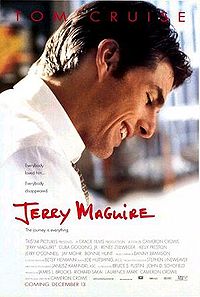
Proof that Great Romantic Comedies Do Exist: "Jerry Maguire"


This is part of a recurring series in which I review some of my all-time favorite movies.


In many ways, Cameron Crowe's Jerry Maguire served as my introduction to the movies, and not just because my five-year-old self had an eerie resemblance to six-year-old Jonathan Lipnicki. This is the film that cultivated my love for cinema. In an era in which so many romantic comedies come dead on arrival, Jerry Maguire is a cinematic miracle that to this day continues to instill in the viewer a warm sense of nostalgia. Jerry Maguire is a deeply moving and wonderfully entertaining love story that is simply impossible to resist. Even the most misanthropic and cynical of people will swoon over this movie, the most impressive entry in Cameron Crowe's accomplished filmography.


Tom Cruise stars as Jerry Maguire, a highly successful sports agent who becomes disillusioned with the materialistic nature of his profession. When he writes an essay expressing his dissonance about the sports management industry, he draws the ire of his bosses, and is suddenly fired. The firing deals Jerry a major psychological blow, and he sinks into a dispassionate malaise. One of his co-workers, however, admires Jerry's courage and ambition and decides to quit the company to help Jerry embark on a new professional endeavor. She is Dorothy (Renee Zelwegger), a single mother of one, and the two quickly fall in love. Along with the help of Dorothy, her adorable young son (the aforementioned Jonathan Lipnicki), and his ebullient star client (Cuba Gooding, Jr.), Jerry attempts to alleviate the stress that has permeated his life in the aftermath of his dismissal at Sports Management International.


The previous paragraph is an extremely brief overview of the plot that may make the movie sound overly maudlin, predictable, and sentimental. Jerry Maguire is anything but. Cameron Crowe's terrific screenplay and his beautifully focused direction ensures that "Jerry Maguire" is always grounded in true, honest emotion. Jerry Maguire explores the familiar themes of love and perseverance in profoundly affecting ways, and the result is something close to perfection. Crowe is also buoyed by the excellence of his actors. Tom Cruise has been a media pariah in recent years, but his performance in Jerry Maguire reminds us that he really is an extraordinary actor. In Jerry Maguire, Cruise is the epitome of a movie star, delivering a performance of suave charm and deep emotion. It is the best work of his career, and that is saying something. The wonderful Renee Zelwegger matches Cruise every step of the way. Zelwegger exudes the type of irresistible enchantment that shows why she is such a talented and versatile actor. And Cuba Gooding, Jr. is magnificent in an unforgettable performance that won him an Oscar.


Jerry Maguire is often most easily associated with the catchphrase, "Show Me the Money!". But that line of dialogue is just one of the many great moments in this truly outstanding movie. In 1996, I fell in love with the movies. I have Cameron Crowe to thank.


Saturday, April 9, 2011

Moral Conviction in the Pursuit of Justice: "12 Angry Men"


Sidney Lumet, a legend of cinema and one of the greatest filmmakers to have ever lived, passed away today at the age of 86. In honor of Mr. Lumet, here is my review of his 1957 classic, "12 Angry Men":


The twelve jurors commence their deliberations on a sweltering summer day in New York City. It is their duty to decide the fate of the teenage defendant, who is charged with the murder of his father. If the twelve men find the defendant guilty, then he will be sentenced to death. When the twelve men convene in an overheated room to discuss the matter at hand, eleven of the men seem thoroughly convinced of the defendant's guilt. They crack jokes about the supposed obviousness of the case. Only a fool would think that the defendant is innocent. One of the men suggests that they take a quick vote and get over with it. After all, he ain't got all day, and he has tickets to the Yankee game later that night. One juror, however, votes not guilty. The rest of the jurors are flabbergasted. How can this man possibly believe that the boy is innocent? The dissenting juror calmly states his case, explaining that the case at least warrants a thoughtful discussion. The dissenting juror wants to ensure that all aspects of the case are reflected upon before the jury decides to send the teenage boy to his death. The dissenting juror proceeds to explain why he believes that the boy might be innocent. As time progresses, the atmosphere becomes increasingly hot, both literally and metaphorically. Tensions escalate, and one-by-one, the remaining eleven jurors become convinced of the boy's innocence.


The entirety of Sidney Lumet's 12 Angry Men takes place inside the jury room, and that is what makes the film so extraordinarily compelling. 12 Angry Men is as great a film as has ever been made, a stunning achievement that continues to endure 54 years after its initial release. The beauty of this magnificent movie is that the viewer feels an intense sense of proximity to the jurors. Lumet's fimmaking is so effective and involving that the viewer can tangibly feel the stifling heat of the deliberation room. The viewer can tangibly feel the tempers and insecurities of the jurors. Very few films leave such a profound emotional impact.


12 Angry Men is the epitome of an ensemble work. The cast is uniformly astonishing. Henry Fonda is a revelation as the dissenting juror who slowly but surely convinces the remaining jurors of the boy's innocence. Lee J. Cobb is brilliant as a bitter juror who is wrestling with some inner demons due to his fractured relationship with his son. Jack Warden is mesmerizing as an impatient juror with a desperate yearning to end his jury duty so he can attend the Yankees game. Ed Begley is superb as a bigoted juror whose prejudice prevents him from making an impartial assessment of the defendant. Martin Balsam, John Fiedler, E.G. Marshall, Jack Klugman, Edward Binns, Joseph Sweeney, Robert Webber, and George Voskovec are also excellent as the remaining jurors. The Reginald Rose screenplay is a work of thrilling perfection, a searing look inside the minds of the jurors and the heavy burden that has been placed upon them. The film is flawlessly edited by Carl Lerner, as it moves at a breathtaking pace. There is never a dull moment.


The driving force behind the film, however, is the late great Sidney Lumet. 12 Angry Men is the work of a master in full command of his craft. Every frame of 12 Angry Men is an exercise of precise genius. Every shot is deftly executed. One of the most ingenious aspects of 12 Angry Men is the way Lumet handles the scenes related to the inclement weather. In lesser hands, using turbulent weather as a metaphor for burgeoning discord could seem forced. But in the masterful hands of Mr. Lumet, the metaphor is an enormously powerful one. Sidney Lumet made some of the greatest films of all-time (Dog Day Afternoon, Serpico, Network, The Verdict), and in 2007, at the age of 82, Lumet made the brilliant Before the Devil Knows You're Dead, a testament to his ageless talent. As great as those films are, however, 12 Angry Men is Mr. Lumet's best. 12 Angry Men is an endlessly captivating reminder of Sidney Lumet's remarkable career.


Wednesday, April 6, 2011

A Celebration of Music, Love, and Friendship: "That Thing You Do!"


This is part of a recurring series in which I review some of my all-time favorite movies.


That Thing You Do! is the type of movie that makes you want to hug a stranger. Here is a film of radiant joy and warmth, an absolutely irresistible delight that lifts the spirit and soothes the soul. That Thing You Do! was written and directed by the great Tom Hanks, who also stars in the film, and it is a testament to Hanks' tremendous charisma and talent. Set in 1964 and released in 1996, That Thing You Do! still feels as fresh as a summertime breeze. I love this movie.


In many ways, the film is a love letter to The Beatles, and to music in general. The plot centers on a wildly popular 1960's rock-and-roll band named The Wonders, a group of young and attractive music aficionados who start a band and experience rags-to-riches success. The four men who comprise The Wonders (Steve Zahn, Ethan Embry, Johnathon Schaech, Tom Everett Scott) are greeted with euphoria by an adoring public, and they quickly become international sex symbols. That Thing You Do! chronicles the The Wonders' rapid ascendance from obscurity to fame, a rise that features a fair share of tumult along the way. But at its core, That Thing You Do! is about the intersection of music, love, and friendship. And That Thing You Do! is remarkably adept and moving in the way it handles the aforementioned themes.


The movie is perfectly cast. Steve Zahn, Tom Everett Scott, Ethan Embree, and Johnathon Scaech all bring youthful ebullience and innocence to the starring roles. They are wonderful. Tom Hanks is fantastic, as always, as the band's manager. Liv Tyler and Charlize Theron are superb as the love interests. In bad movies, the role of love interest can be a thankless one, but That Thing You Do! gives Tyler and Theron characters that feel real. Tom Hanks' screenplay is a funny and charming gem, and his direction is vibrant and enchanting.


The real star of That Thing You Do!, however, is the music. The soundtrack is simply magnificent, each song a toe-tapping pleasure. It is impossible to finish watching the movie without humming the catchy title track, "That Thing You Do". The soundtrack serves as a joyous ode to the magic of music, and the ability of music to ease your worries and bring happiness.


That Thing You Do! isn't especially groundbreaking, but it is richly satisfying every step of the way. This movie is entertainment at its finest. Tom Hanks never got the credit he deserved for making a movie so full of life, so full of enchantment.


Sunday, April 3, 2011

A Fight for Redemption and a Struggle to Belong: "The Wrestler"


This is part of a recurring series in which I review some of my all-time favorite movies.


There is something undeniably life-affirming about The Wrestler, Darren Aronofsky's stunning knockout about an aging wrestler's struggle to rebuild his life after a litany of professional and personal setbacks. I continue to watch The Wrestler with increasing regularity, and after each viewing I emerge profoundly moved. There is a little part of all of us in Randy "The Ram" Robinson, one of the most authentic and compelling characters ever put on screen. Deeply flawed but bracingly human, Randy "The Ram" is a man fighting to reconcile with his daughter and to achieve belonging in a violent profession. He is a man who bears deep emotional and physical scars, and the viewer becomes thoroughly invested in his struggle. You can't help but passionately root for Randy "The Ram", and this connection between viewer and cinema protagonist makes The Wrestler a magnificent triumph.


On paper, The Wrestler seems to have the trappings of a conventional comeback story. But the beauty of Robert Siegel's breathtaking screenplay is that it stays heartbreakingly real to the very end, avoiding the contrived pratfalls of so many other Hollywood redemption stories. Every frame of this film is grounded in the sorrows and triumphs of real life. And the ending is brilliant precisely because it is not tidy or feel-good, but rather messy and challenging, just like life itself. Furthermore, the directorial vision of Darren Aronofsky is assured and focused. Aronosfky, who also directed last year's amazing Black Swan, is a master at exposing the bare emotions of reality against the backdrop of personal tumult. He is one of the world's finest filmmakers.


Even if the rest of the film was flawed, The Wrestler would still be worth watching for the masterful performances. Mickey Rourke, whose own life shares many parallels with Randy "The Ram", gives the performance of a lifetime in the lead role, a performance that should have won him an Oscar. Rourke tackles an extraordinarily demanding role with astonishing fearlessness. Simply put, it is one of the greatest pieces of acting I have ever seen. Marisa Tomei matches Rourke every step of the way with a performance of devastating vulnerability and raw emotion. Like Rourke, Tomei takes an enormously challenging role and delivers a tour-de-force. Evan Rachel Wood is also outstanding as the daughter with whom Randy "The Ram" is trying to reconcile. The scene between Mickey Rourke and Evan Rachel Wood that takes place on the Asbury Park boardwalk is, simply put, perfect.


The Wrestler is my favorite film of the last decade, and one of my favorite films, period. The Wrestler is the type of film that transcends the boundaries of movies, a movie that moves beyond mere entertainment. The Wrestler is a testament to the soothing power of cinema.