Thursday, July 23, 2009

Guy Meets Girl. You Know the Rest.


Even when judging by the relatively low standards of formulaic romantic comedies, "The Answer Man" is particularly terrible. Here is a film that recycles every cliche known to man, including the inevitable closing scene in which the guy wins over the girl by chasing after her in the streets to deliver one of those schmaltzy monologues that we've heard a thousand times before. Worst of all, "The Answer Man" is dreadfully dull and unfunny. The so-called humor in this movie is far too bland and timid. Don't let the R rating fool you. "The Answer Man" is as tame and harmless as a puppy dog.

Jeff Daniels stars as Arlen Faber, a renowned author whom everyone assumes has all the answers to life's most challenging questions. He is a beloved figure in the literary world, yet Arlen Faber is a prickly jerk. That is one day until he meets Elizabeth (Lauren Graham), a charming and attractive single mother who also happens to be Arlen's chiropractor. Arlen immediately falls in love. Do I need to explain the rest? Their relationship hits the obligatory bumps in the road that is to be expected in films like this, but in the end they live happily ever after. Oh yeah, there is also a subplot involving an alcoholic, down-on-his luck book store owner. I suppose that this subplot is meant to tug at your heartstrings, but it just feels treacly and manipulative. All this is set to a shamelessly corny soundtrack that acts as its own annoying character.

There are a lot of talented people involved with "The Answer Man". Jeff Daniels is a brilliant, under appreciated actor whose filmography includes such great films as "Terms of Endearment", "The Purple Rose of Cairo", "Pleasantville", "The Hours", "Good Night and Good Luck", and "The Lookout". I'm guessing he just did this movie for the paycheck. And Lauren Graham is effortlessly lovely and charming in every film in which she appears. But there is nothing that Daniels and Graham can do here. The screenplay by writer-director John Hindman is so tired, the dialogue so predictable, that Daniels and Graham are forced to overact.

There is, however, one line in "The Answer Man" that made me laugh. Arlen Faber is asked if he believes in hell. He replies that he has been to hell, and it is called Reno, Nevada. I laughed. Granted, it's kind of a cheap joke, but in a movie as bad as "The Answer Man", you take what you can get.


Saturday, July 18, 2009

The Life of An Incurable Misanthrope


I've never subscribed to the popular theory that Woody Allen is past his prime. Many filmgoers seem to believe that Allen has become increasingly lazy as a filmmaker, an idea that I consider to be completely foolish. In the past six years, Woody Allen has proven that he is still a masterful cinematic auteur. In 2005, Allen made "Match Point", a sexy and thrilling tour de force that is one of his best films. Last year, Allen gave us the seductive and visually dazzling "Vicky Cristina Barcelona", a film for which Penelope Cruz won an Oscar. In this decade, Allen has also made "Anything Else" and "Melinda and Melinda", two criminally underrated comedies that delivered very big laughs. So no, I do not believe that Woody Allen has lost his touch. One could argue that he has yet to equal the brilliance of "Hannah and Her Sisters" and "Annie Hall", but that's like saying Francis Ford Coppola has yet to make a better film than "The Godfather". America's favorite neurotic remains one of the greatest, most prolific filmmakers around, regardless of what you may have heard. However, even great filmmakers stumble once in a while, and this is the case with Allen's latest effort, "Whatever Works". This film is a wildly uneven, mildly amusing, and occasionally diverting misfire that shows flashes of brilliance without ever fulfilling its potential.


"Whatever Works" takes us inside the life of Boris Yelnikoff (Larry David), an incessantly misanthropic curmudgeon who treats everybody with stunning rudeness and disrespect. Boris believes that life is an absolutely meaningless endeavor. He considers himself a genius, the only person who can see the big picture. Boris regularly teaches chess lessons to young kids, but those lessons merely consist of him berating the children for their utter stupidity. Boris walks with a noticeable limp, for he once tried to commit suicide by jumping off a balcony, only to land on the canopy. One night outside of his New York City apartment, Boris is confronted by a young woman (Evan Rachel Wood) in her twenties from Mississippi named Melody. She has run away from home and is looking for a place to stay. Boris reluctantly agrees to provide shelter for the woman, despite his obvious disdain for her inferior intellect. As the days pass, however, Melody develops a crush on Boris. She becomes persuaded by his pessimistic world view, and soon enough, with an age difference of forty years, Boris and Melody marry.

This plot sounds like great material, but "Whatever Works" never takes full advantage of it. The movie is riddled with problems. First of all, Melody seems far too much like a caricature, playing off the tired "dumb blonde" cliche. Evan Rachel Wood gives a spunky performance, but she speaks in a greatly exaggerated Southern drawl that is distracting and slightly annoying. Wood has enormous talent, as evidenced by her superb work alongside Mickey Rourke in "The Wrestler", but her acting here feels strained. Secondly, "Whatever Works" has Boris frequently interrupt the movie and speak directly to the audience, aware that he is in a movie. Granted, this technique is a Woody Allen trademark that worked beautifully in "Annie Hall", but this self-conscious style feels out of place in "Whatever Works". The movie also suffers from frequent dry spells. There is an unnecessary storyline involving a handsome bachelor trying to woo Melody that feels like it was yanked out of a conventional rom-com. This part of the film gets bogged down in cliche.

Despite all of these glaring flaws, "Whatever Works" has some truly great moments. There is a very funny subplot involving Patricia Clarkson and Ed Begley, Jr. as Melody's deeply religious parents who undergo two drastic shifts in personality. Larry David, taking over a role that in years past would have been played by Woody Allen himself, is excellent, playing a cantankerous character that is reminiscent of his work in "Curb Your Enthusiasm", one of the funniest shows in the history of television. Boris is downright unpleasant, but just as he does on "Curb", Larry David manages to make even the rudest of guys somewhat endearing. And Woody Allen, even though his script is inconsistent, still manages to provide some hilariously witty dialogue to remind us that he is one of the best screenwriters ever. The last twenty minutes or so are particularly strong, with dialogue that is vintage Woody Allen.

So "Whatever Works" is not a bad film. But there are too many flaws for me to recommend it. I hold Allen to a high standard, and this is a middle-of-the-road entry to his filmography. But Woody Allen is not past his prime. Even in a film that is ultimately disappointing, Allen shows enough to prove that he still has game.


Wednesday, July 15, 2009

Catching Up On Films I've Missed


I try to see as many movies as I can in theaters, but I do not have enough time to see them all. I try to catch as many films as possible on DVD, but many films slip through the cracks. Fortunately, it is summer, and what better thing to do on warm summer evenings than watch movies in the confines of your own home. Here are some movies that I have finally got around to seeing in the past couple of weeks. Some are relatively recent; some are pretty old. I'm going to try to make this a recurring segment on this blog. With no further ado, here are my thoughts on films that I missed when they were in theaters:

"Last Chance Harvey": Unfortunately, this wonderful film got lost in the winter shuffle last year. Dustin Hoffman and Emma Thompson have amazing chemistry in a movie that is genuinely moving and sublimely acted. I love "Last Chance Harvey".

"The Heartbreak Kid" (the 2007 remake): The same cannot be said of this horribly unfunny Farrelly Brothers' remake of a 1972 classic. This is simply a mean-spirited collection of ancient cliches. Ben Stiller gives a game effort, and the shots of San Francisco are gorgeous. But this is a disaster.

"Vanilla Sky": This 2001 movie got ripped by critics, and guess what, I loved it. Cameron Crowe crafted a haunting, trippy masterpiece, with outstanding performances from Tom Cruise, Penelope Cruz, and Cameron Diaz. The plot is extremely convoluted, blurring fiction and reality, but the script by Crowe is thoroughly involving. One of the more underrated movies of the decade.

"Good Morning, Vietnam": I can't believe it has taken me this long to see Barry Levinson's 1987 classic, but it was more than worth the wait. Robin Williams gives one of the best performances of his career as an American radio D.J. whose irreverent broadcasts in the Vietnam War inspired the soldiers. Williams is at his improvisational best during the radio scenes, and strong supporting work comes from Forest Whitaker and Bruno Kirby. One of Levinson's best films, "Good Morning, Vietnam" examines the fascinating themes of escapism, non-conformity, and comedy, all set to the backdrop of the war.

"Nobel Son": One of the noisiest, most self-conscious movies I have ever seen. "Nobel Son" suffers from an identity crisis, shifting wildly between scenes of comedy and scenes of gory violence. Alan Rickman and Mary Steenburgen are both excellent, but it is hard to focus on the performances in a film that is this distractingly bad.

"Definitely, Maybe": What a refreshingly original and charming movie this is. Writer-director Adam Brooks makes a romantic comedy that is really, really good, and how rare is that! Every performance in this movie, from Ryan Reynolds to Isla Fisher to Elizabeth Banks to Abigail Breslin to Kevin Kline, is wonderful.

"I've Loved You So Long": Following "La Vie en Rose" and "Roman de Gare", "I've Loved You So Long" is yet another masterpiece from the world of French cinema. Kristin Scott Thomas is a revelation as a woman struggling to readjust to normalcy after spending fifteen years in prison. This film does not hit one false note. Even the surprise ending feels natural, free of manipulation. This is a truly great film.


So there you have it. I strongly recommend "I've Loved You So Long", "Good Morning, Vietnam", "Last Chance Harvey", "Vanilla Sky", and "Definitely, Maybe". But please, whatever you do, stay away from "The Heartbreak Kid" and "Nobel Son".

Sunday, July 12, 2009

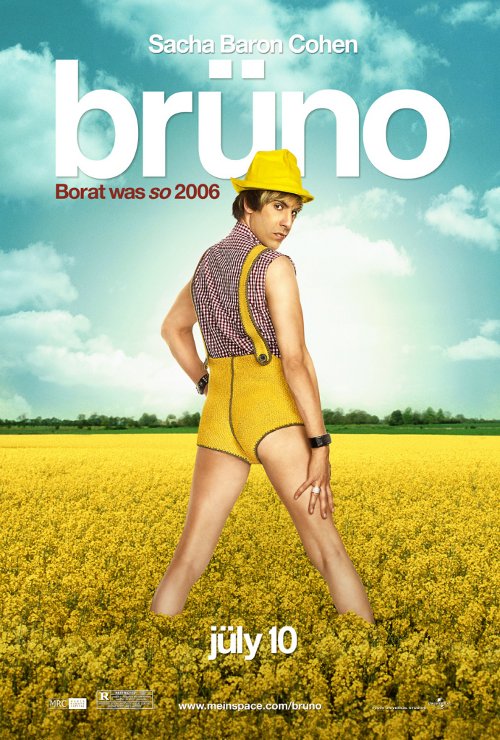
America, Say Hello to Bruno


Three years removed from "Borat", Sacha Baron Cohen has made yet another work of daring comic genius. Here is a shockingly bawdy, hysterically funny film that also has a social conscience. And how rare is that. "Bruno" will no doubt appall audiences with its raunch, making viewers laugh and squirm, often simultaneously. But beyond the comedy is a socially relevant commentary on American culture. As he did in "Borat", Sacha Baron Cohen uses "Bruno" as a vehicle through which he exposes the still prevalent existence of prejudice in our society. And did I mention it's funny?

The plot is pretty straightforward. Bruno, a flamboyantly gay fashionista from Austria, comes to America in hopes of becoming "the most famous gay Austrian entertainer since Arnold Schwarzenegger." In one of the film's most hilarious scenes, Bruno markets his television show to an unassuming focus group, and they are, to say the least, disgusted by what they see. In one of the film's raunchiest sequences, Bruno attends a swinger's party and walks around providing words of motivation, and asks if anyone wants a sandwich. You get the drift. The comedy in "Bruno" is strikingly similar to the comedy in "Borat", but so what? As long as Cohen continues to hit his targets with comic precision, his work will still come across as innovative.

Sacha Baron Cohen remains the most courageous man in show business, willing to place himself in the middle of seriously dangerous situations. If you think I'm exaggerating, wait until you see the scene in which Bruno sits by the campfire in the barren woods on a hunting trip with four homophobic men, with all four of the men looking as if they want to strangle him. Or the scene in which Sacha Baron Cohen, disguised as a wrestler, starts making love to his opponent in the ring, while the drunken, violent crowd throws chairs in his direction. Or the scene in which Bruno gets continually whipped by a dominatrix. The remarkable thing about Cohen is that he never loses character, not even in these scary situations. It's a magnificent performance of incredible consistency.

Many people will no doubt accuse "Bruno" of being homophobic, surely the same people who called "Borat" anti-Semitic, even though Sacha Baron Cohen is himself Jewish. What these people fail to realize is that the intent of "Borat" and "Bruno" is to denounce bigotry, not encourage it. By making Bruno such a flamboyantly gay character, and by pushing the limits of the R rating so strongly, "Bruno" tears the lid off what is considered socially acceptable, forcing even the most liberal, open-minded person to confront their own inner prejudices. Yes, "Bruno" is an outrageously funny, insanely ribald comedy. But most of all, "Bruno" is a call for tolerance.

Friday, July 10, 2009

Living the Gangster Life in the Public Eye


"Public Enemies" chronicles the life of 1930's gangster John Dillinger, one of the most fearless villains to have ever graced the silver screen. Say what you want about Dillinger, public enemy number one throughout the 1930's. But boy did he have guts. It wasn't uncommon for Dillinger, for example, to sit quietly and calmly in a packed movie theater while his mug shot is being shown on the movie screen and everyone in the crowd ordered to look around in search of America's most wanted man. It wasn't uncommon for Dillinger to casually take a stroll inside the Chicago police department headquarters, fraternizing with the cops around him. John Dillinger loved to flirt with danger. For Dillinger, robbing banks was a profession, and he proceeded in this profession with unflappable cool.

"Public Enemies", the latest film from director Michael Mann ("Heat"; "Collateral"), is an intensely fascinating study of this intensely fascinating man. "Public Enemies" does not attempt to explain John Dillinger; it simply tries to examine his life. The result is, for the most part, chillingly effective. This is due in large part to the first-rate acting from the two leads. Johnny Depp is brilliant in the lead role. His portrayal of Dillinger is an exercise in suave understatement, and Depp somehow manages to invoke emotion with a simple sly grin. Marion Cotillard, a spectacular beauty who won an Oscar two years ago for her breathtaking work in "La Vie en Rose", is stellar as Dillinger's emotionally conflicted lover. The scenes between Depp and Cotillard are the film's best. Chemistry is a tricky thing to achieve, but it is an easy thing to recognize, and Depp and Cotillard have a sizzling rapport.

"Public Enemies" is infused with Michael Mann's trademark style. Mann, whose "Heat" and "Collateral" are two of the most criminally underrated films of the last twenty-five years, perfectly captures the essence of 1930's Chicago. The film, shot with handheld cameras, has a visually alluring appeal that invites the viewer inside the dark and violent world of gangster life. Mann gives "Public Enemies' a documentary feel that creates an intimate connection between Dillinger and the audience.

With this being said, "Public Enemies" falls a little shy of greatness. With a bloated running time of 140 minutes, the film occasionally loses its' focus. Too much time is devoted to the other gangsters of the era, including Pretty Boy Floyd and Baby Face Nelson. "Public Enemies" would have been better served if John Dillinger was the sole focus of the movie. But these are minor quibbles in a movie that is ultimately richly satisfying. I walked out of the theater amazed at the sheer audacity of public enemy number one, John Dillinger.