Thursday, December 31, 2009
Once Upon a Time, In a Far Away Land...
Sunday, December 13, 2009
A Divided Nation Unites Over Rugby
"Invictus", the latest film from the great Clint Eastwood, seems to have all the trappings of just another formulaic sports picture. After all, this film tells the story of the plucky underdog who prevails against all odds, achieving greatness in dramatic, last-second fashion in the championship game. Thus, this film should have been nothing more than a bland, conventional exercise. In the hands of Eastwood, however, "Invictus" is something much more than that. On the surface, this movie is about the improbable championship season of the South Africa Springbok rugby team. More importantly, however, "Invictus" is an uncommonly moving film about racial reconciliation in post-apartheid South Africa.
"Invictus" focuses on the South Africa Springbok rugby team in post-apartheid South Africa. The green and gold colors of the Springbok, and their predominantly white roster, made them a symbol of the hated apartheid system. When Nelson Mandela was elected president in 1994, he was receiving intense pressure by the black South African community to ban the colors of the Springbok. Mandela, aware that he was making an unpopular decision, ignored this populist discontent and instead threw his complete support behind the Springbok rugby team. Mandela, who spent twenty-seven years as a prisoner due to his anti-apartheid protestations, expressed an incredible willingness to forgive the people who put him in prison in the first place. Mandela argued that racial reconciliation was far more important than petty revenge, and he felt strongly that a victory for the Springbok in the World Cup would unite and lift the spirits of a divided nation. He formed a special relationship with the captain of the Springbok, Francois Pienaar, who became inspired by Mandela's support. Buoyed by Mandela's unwavering support, the Springbok went on to win the World Cup, a small but undeniably significant step toward racial healing in South Africa.
This story could have easily turned into a sappy, sanitized misfire, but Eastwood handles the material with effortless grace. "Invictus" occasionally veers into the realm of sports movie formula in its final act, but for the most part Eastwood tells the story in a surprisingly moving and novel fashion. He is helped in large part by the strength of the two leads, Morgan Freeman and Matt Damon. The great Morgan Freeman gives another brilliant performance as Nelson Mandela, the role he was born to play. Freeman utters Mandela's words with such poetic beauty that he elevates the film's sometimes preachy dialogue. Freeman deserves an Oscar nomination for his performance. Matt Damon is also terrific as Francois Pienaar, convincing as a man who feels he owes it to his country to win the World Cup.
"Invictus" is a rousing crowd pleaser, one of the most inspirational films of the year. Most of all, "Invictus" is a tribute to the heroism and courage of Nelson Mandela, a man who risked his own reputation for the betterment of his nation.
Saturday, December 5, 2009
The Thirty Best Films of the Decade
The decade is winding to a close, and it is time to reflect on what was a splendid decade in the world of cinema. The 2000's was a decade for the greats, as cinematic legends Martin Scorsese, Clint Eastwood, and Steven Spielberg all made multiple masterpieces. With no further ado, here are my picks for the thirty best movies of the past decade, listed in reverse chronological order:
30. "The Good Shepherd" (2006)
Robert DeNiro's lengthy, spellbinding espionage thriller came and went in 2006, and it received a tepid response from critics. For my money, "The Good Shepherd" is one of the best espionage movies ever made. DeNiro works wonders with an all-star cast (Matt Damon, Angelina Jolie, Alec Baldwin, John Tuturro), and his direction is an exercise in noirish style. By the end of this 167-minute epic, I was exhilarated by this film's surprising emotional pull.
29. "Before the Devil Knows You're Dead" (2007)
The great Sidney Lumet proved that he hasn't lost a step with this gritty, chronologically jumbled masterpiece about two down-on-their-luck brothers (Phillip Seymour Hoffman, Ethan Hawke) who plot the robbery of their parents' jewelry store, with tragic consequences. Hoffman and Hawke are brilliant in the lead roles, and Marisa Tomei is astounding. The fact that she did not receive an Oscar nomination for her performance is one of the biggest cinematic crimes of the last decade.
28. "Away From Her" (2006)
In lesser hands, the story of a husband struggling to cope with his wife's Alzheimer's could have turned into a shamelessly sentimental exercise. In the hands of writer-director Sarah Polley, this material made for one of the most emotionally authentic and heartbreaking films of the decade. Julie Christie earned an Oscar nomination for her beautiful work in this film, and Gordon Pinsent may have given the most underrated performance of the decade as Christie's husband. "Away From Her" never hits a false note, as each scene is handled with delicate grace.
27. "Bowling for Columbine" (2002)
I have greatly admired all of Michael Moore's work in this past decade ("Fahrenheit 9/11", "Sicko", "Capitalism: A Love Story"), but the one film that stands above them all is "Bowling for Columbine". Thirteen years after hitting the scene with "Roger & Me", Moore put his muckraking anger and bitter sarcasm to brilliant use in this caustic examination of the nature of guns and violence in the United States. Whether or not you agree with Moore's message is beside the point. The bottom line is that this is filmmaking at its' most polarizing, and that needs to be applauded.
26. "The Diving Bell and the Butterfly" (2007)
One of the most visually beautiful movies I have ever seen, "The Diving Bell and the Butterfly" marked the arrival of a new star in director Julian Schnabel. Schnabel brings the astonishing story of Jean-Dominique Bauby to vivid life, and the result is nothing short of spectacular. "The Diving Bell and the Butterfly" is part of what has been a tremendous decade for French cinema.
25. "Vanilla Sky" (2001)
Cameron Crowe's criminally misunderstood 2001 film was ripped to shreds by critics. Granted, it features one of the most convoluted plots in recent memory. However, I was enthralled by every frame of this dizzying gem. Crow makes superb use of non-linear storytelling, and terrific performances are turned in by Tom Cruise, Penelope Cruz, and Cameron Diaz.
24. "Catch Me If You Can" (2002)
If you don't have a blast watching Steven Spielberg's wildly entertaining "Catch Me if You Can", then you don't love the movies. The fascinating story of charming, ingenious con man Frank Abagnale, Jr. makes for richly satisfying cinema. Leonardo DiCaprio and Tom Hanks have a fantastic rapport, and Christopher Walken is stunning as Abagnale's sincere, financially troubled father.
23. "Hotel Rwanda" (2004)
Terry George's chronicling of the Rwandan genocide deals with some painfully gut-wrenching history, but at the heart of this movie is the heroic, inspirational life story of Paul Rusesabagina. Rusesabagina is portrayed by Don Cheadle in a sensational piece of acting that is to this day Cheadle's finest performance, and that is saying something. Sophie Okonedo is also brilliant as Ruseabagina's wife.
22. "Dirty Pretty Things" (2002)
I walked into Stephen Frears' gritty, uncompromising tale of the lives of two London illegal immigrants completely unprepared for the emotional tour de force I was about to witness. "Dirty Pretty Things" introduced me to Chiwetel Ejiofor, an unbelievable actor who has consistently dazzled me in films such as "Children of Men", "Kinky Boots", "Melinda and Melinda", "Inside Man", and "American Gangster".
21. "A Beautiful Mind" (2001)
Ron Howard's 2001 Best Picture winner has come under fire in recent years for its' alleged laziness regarding its' historical accuracy toward mathematician John Nash. Speaking on purely cinematic terms, however, this is a masterpiece. Russell Crowe has given his fair share of excellent performances in the 2000s ("American Gangster", "Gladiator", "Master and Commander"), but his work in "A Beautiful Mind" tops them all. Ron Howard's film works on a myriad of levels, both a fascinating biopic and an involving thriller.
20. "Ray" (2004)
Jamie Foxx gives the performance of a lifetime in "Ray", an electric, moving biopic of the late great Ray Charles. Foxx perfectly captures the spiritual essence of one of the greatest musician of all-time. However, Taylor Hackford's film is not just a one-trick pony. Hackford, working from the exemplary James L. White screenplay, crafts a movie that has a spirit and energy that is consistent with Ray Charles' life.
19. "La Vie en Rose" (2007)
Marion Cotillard knocked me out with her portrayal of the brilliant, deeply troubled Edith Piaf, a performance that earned Cotillard an Oscar. Like "Vanilla Sky"and "Before the Devil Knows You're Dead", "La Vie en Rose" uses non-linear storytelling to great effect. Along with "The Diving Bell and the Butterfly" and "Roman de Gare", "La Vie en Rose" is part of a dynamic decade of French cinema.
18. "Minority Report" (2002)
Steven Spielberg's mix of science fiction magic and character study realism is what makes this film so special. Tom Cruise is outstanding in the lead role, a performace that should have earned him some love from the Academy. When writing about "Minority Report", the great Roger Ebert put it best: "At a time when movies think they have to choose between action and ideas, Steven Spielberg's "Minority Report" is a triumph-----a film that works on our minds and our emotions." Amen to that.
17. "About Schmidt" (2002)
There is nothing more satisfying than watching a legend flash his greatness, and that is exactly what Jack Nicholson does in "About Schmidt". Nicholson's portrayal of an aging retiree who goes on a road trip after the death of his wife is absolutely stunning, a performance that ranks right up there with Nicholson's best work. As a whole, "About Schmidt" is an authentic, deeply moving film that speaks to the difficulty of finding solace in life.
16. "Juno" (2007)
It's a rare feat when a movie makes you want to hug everybody inside the movie theater, but "Juno" had that effect on me, a testament to its' winning, heartwarming nature. Diablo Cody's debut screenplay is a snappy, smart, funny, and authentic miracle. And after watching Ellen Page's winning performance, I immediately fell in love with her. Can you tell how much I love "Juno"?
15. "Million Dollar Baby" (2004)
Clint Eastwood's poetic masterpiece about the triumph and tragedy of a female boxer could have easily resorted to sappy sentimentality, but in the masterful hands of Eastwood, this is a profoundly beautiful film. What makes this film so special is the relationship between Eastwood's aging trainer and Hilary Swank's plucky boxer. Eastwood gives one of his finest performances, Swank turns in the best work of her accomplished career, and the great Morgan Freeman is stellar in a supporting role that won him his first career Oscar.
14. "Match Point" (2005)
This was Woody Allen's best film in years, a sexy, mesmerizing tale of romance and murder. The backdrop of London gives this film an alluring look, and Jonathan Rhys-Meyers and Scarlett Johansson burn up the screen with sizzling chemistry. "Match Point" is one of Woody Allen's towering achievements, a film that belongs to be mentioned in the same breath as "Annie Hall", "Hannah and Her Sisters", and "Crimes and Misdemeanors".
13. "Once" (2007)
The term "movie magic" was created just for movies like "Once", movies that lift your spirit and fill your heart in ways that you can never expect. The plot of "Once"----the story of the relationship between two struggling musicians in Dublin----doesn't sound like the makings of anything revolutionary. But the sublime execution, from the gorgeous music to the irresistible charm of the two leads (Glen Hansard and Marketa Irglova), makes "Once" one of the most satisfying movies of the decade.
12. "Crash" (2005)
Many people found Paul Haggis' 2005 Best Picture winner to be a heavy-handed and manipulative film about race. I found "Crash" to be an honest, extraordinarily powerful masterpiece about the complicated state of race relations in the United States. Uncompromising but ultimately uplifting, "Crash" is a film that dares to ask challenging questions, a film that sparks fierce debate and conversation.
11. "Elephant" (2003)
Gus Van Sant's chronicling of a Columbine-like massacre at a Portland high school is one of the most unflinching movies ever made. This is a film of undeniable emotional power, as Van Sant takes us inside the lives of several kids who are about to be a part of a tragic school massacre. Van Sant chose to not use professional actors in this film, and that gives "Elephant" a more foreboding, authentic feel.
10. "Best in Show" (2000)
Of all of Christopher Guest's brilliant mockumentaries ("A Mighty Wind", "Waiting for Guffman, "For Your Consideration"), "Best in Show" is the one that best stands the test of time. This is one of the funniest movies ever made, a pitch-perfect satire on those silly dog show extravaganzas. An all-star cast of Chris Guest regulars, from Eugene Levy to Michael McKean to Jane Lynch to Larry Miller to Jennifer Coolidge to Catherine O'Hara to Fred Willard to Harry Shearer, all deliver huge laughs. "Best in Show" is comic gold.
9. "Mystic River" (2003)
The first of three masterpieces from Clint Eastwood this past decade, "Mystic River" takes us on an exceptionally compelling journey into the lives of three longtime friends in Boston, who each struggle to cope with the aftermath of a tragic event. Based on the novel by Dennis Lehane, "Mystic River" features beautifully subtle direction from Eastwood and sensational performances from Sean Penn, Tim Robbins, and Kevin Bacon.
8. "Michael Clayton" (2007)
Simply put, this is a perfect film. Writer-director Tony Gilroy's screenplay is taut and intelligent, giving brilliant material to an all-star cast of George Clooney, Tom Wilkinson, and Tilda Swinton. Clooney is stunning in the lead role, and Tilda Swinton and Tom Wilkinson are both spectacular. The late great Sidney Pollack also deserves mention, reminding us in this film that, in addition to being a first-rate director, Pollack was an invaluable character actor.
7. "Lost in Translation" (2003)
Writer-director Sophia Copolla crafted a movie miracle with this funny, honest, moving, beautifully rendered film. With all due respect to Sean Penn (who was indeed outstanding in "Mystic River"), Bill Murray deserved an Oscar for his tour de force as an aging commercial actor who finds solace and happiness in the form of Scarlett Johansson. Murray and Johansson have a perfect rapport, and the script from Coppola always feels authentic, steering clear of convention and formula at every turn.
6. "The Departed" (2006)
Martin Scorsese made the one of the best films of the 1970's in "Taxi Driver", the best film of the 1980's in "Raging Bull", and one of the best films of the 1990's in "GoodFellas". And with his 2006 gritty crime epic "The Departed", Scorsese has made one of the best films of the 2000's. Every frame of this film pulsates with a booming energy, and Leonardo DiCaprio, Matt Damon, Jack Nicholson, Vera Farmiga, Alec Baldwin, Mark Wahlberg, Martin Sheen, and Anthony Anderson all turn in outstanding work.
5. "Snow Angels" (2006)
The vast majority of the American public probably have never heard of "Snow Angels", and that is a shame. David Gordon Green's masterpiece is essential viewing for any movie buff. "Snow Angels" deals with the subject of suburban tragedy, but due to the grace and beauty of the performances, writing, and direction, this film will inspire rather than sadden. Kate Beckinsale has never been better, and Sam Rockwell shows why he is one of the world's most underrated actors. If you are reading this right now, and you haven't yet seen "Snow Angels", turn off the computer and go to Blockbuster. This is a must-see.
4. "Letters from Iwo Jima" (2006)
As much as I love "Mystic River" and "Million Dollar Baby", "Letters from Iwo Jima" is Clint Eastwood's magnum opus. What separates "Letters" from other WWII movies is that it tells the story from the Japanese perspective. Eastwood knows better than to politicize this material, focusing rather on the lives of decent, honest men, fighting a war not by choice, coping with the same stress and tragedy that all American soldiers face. The acting, most notably, from Ken Watanabe, is exceptional, and the stark cinematography is powerful, reflecting the grim, barren nature of war.
3. "City of God" (2003)
One of the most exhilarating movies ever made, "City of God" takes us on a wildly entertaining sprint through the crime-ridden streets of Brazil. Fernando Meirelles' masterpiece never stops to take a breath, leaving the viewer exhausted and most off all, mesmerized at filmmaking at its finest.
2. "In America" (2003)
When I wandered into the theater with my parents at the innocent age of 13, I had no idea what to expect. I was about to see Jim Sheridan's semi-autobiographical story of an Irish immigrant family struggling to make ends meet in New York; I knew nothing about the film; I had no expectations. 105 minutes later, I emerged from this incredibly powerful and uplifting film with a newfound love for cinema. Sheridan's writing and directing is pure and honest, and the actors portraying the family (Samantha Morton, Paddy Considine, Sarah Bolger, Emma Bolger) create one of the most heartwarming family relatuionships ever put on screen. Djimon Houndsou is also brilliant, in a performance that earned him an Oscar nomination.
1. "The Wrestler" (2008)
"The Wrestler" is one of the greatest movies I've ever seen, and I say that without the slightest bit of hyperbole. I truly love this film. Darren Aronofsky's film about a down-and-out professional wrestler trying to repair his life never hits a false note. Mickey Rourke gives an amazing, flawless performance that, for my money, is the performance of the decade. Marisa Tomei, meanwhile, gives one hell of a courageous performance. Together, Rourke and Tomei give a clinic in how to act. This is the best film of the decade.
Tuesday, October 20, 2009
Wall Street, Say Hello to Michael Moore
Tuesday, September 29, 2009
The Story of Yet Another Corporate Whistleblower...This Time With Laughs
"The Informant!" opens with a warning, notifying the audience that this isn't your average based-on-real-events docudrama. We are told that certain characters and events have been fictionalized, and this revelation is followed by two defiant words: So there. From this point, it is evident that "The Informant!" will go to the beat of its' own drum. Steven Soderbergh's latest film is the epitome of quirkiness, with every scene making a conscious effort to be offbeat. Sometimes, the quirkiness works in the film's favor, and the subtle humor zings with pitch-perfect accuracy. Other times the quirkiness evolves into a distracting self-consciousness, and this viewer was left unamused at the whole wink-wink, look-how-clever-we-can-get shenanigans of the picture. Ultimately, however, "The Informant!" works more often than not. Or does it? I was so exhilarated and puzzled by this film, I'm not sure what to think.
The story is based on events that transpired in the 1990's, but with our current economic climate, it seems ripped from today's headlines. A much doughier Matt Damon stars as Mark Whitacre, an employee at an Illinois conglomerate who is asked to blow the whistle on the company's price-fixing corruption. But in the midst of his cooperation with the FBI, Whitacre himself becomes consumed in corruption, eventually stealing $9 million and earning a prison sentence that was infinitely longer than that of the felons he was supposed to be tracking.
Now this premise does not sound like the makings of a wacky comedy, but that's part of the quirkiness. "The Informant!" turns this premise into something entirely goofy, and the results are mixed. The strengths lie in the acting and directing. Matt Damon is hilarious in the lead role, giving a performance of heedless energy. Damon has long been an outstanding actor, but this is a joyful side that we rarely see from him. The supporting roles all fit in nicely, especially that of Melanie Lynskey as Whitacre's shockingly supportive wife Ginger. Soderbergh's direction is an exercise in effervescence. Nearly every scene is bright and colorful, literally, a fascinating stylistic approach that blends well with the movie's joyous nature.
The flaws, however, are easy to spot. The writing is wildly inconsistent, veering from zany brilliance to moronic randomness. And the film's biggest fault is it's frantically upbeat score, a score so distracting it should have received higher billing on the marquee than Matt Damon.
So, yes, this review has been an incoherent collection of random, inconsistent thoughts, but hey, that's how I felt during the movie. "The Informant!" is alternatingly funny, brilliant, annoying, and monotonous. I like a movie that keeps you on your toes.
Tuesday, August 25, 2009
An Alternate Version of World War II-----And A Work of Daring Genius
From the riveting opening moments of "Inglourious Basterds", it is evident that this is another daring gem from Tarantino. The film opens with a lengthy, spellbinding scene-----the most involving scene of any movie this year-----that introduces us to Nazi Col. Hans Landa (Christoph Waltz), an astonishingly evil man indeed who nonetheless hides behind his menacing charm. The beginning minutes of "Inglourious Basterds", the details of which I will not divulge, serve as proof that suspense need not be manufactured through the use of car chases or loud explosions, but rather that incredible suspense can be the result of a simple conversation between two men. This is a testament to Quentin Tarantino's brilliant knack for writing compelling dialogue. There are several elements in this movie that makes it a distinctly Tarantino picture-----the visually splendid direction, the sheer audacity, the fantastic soundtrack, the list goes on and on. But the one element that is most consistent in all of Tarantino's films is his writing.
Tarantino's dazzling script is buoyed by the strength of the three lead performances. Brad Pitt is known for his world-famous celebrity, but his acting ability often goes overlooked. Pitt's performance here is an exercise in heedless joy. Pitt throws caution to the wind, clearly having a ball while delivering a terrific performance that is great fun to watch. Melanie Laurent is superb as a German woman who changes her identity after her family was murdered by the Nazis. As good as Pitt and Laurent are, however, the star of this film is Christoph Waltz. As the devilishly charming, spectacularly evil Col. Landa, Waltz creates one of the most memorable villains in movie history. Waltz is absolutely brilliant, and if his name isn't on the ballot come Oscar time, the Academy should be stripped of its authority.
"Inglourious Basterds" is bloody fun, literally. This is a darkly funny work of complete originality that pays tribute to past cinema, most notably spaghetti westerns. Most filmmakers wouldn't go near this type of material, but Quentin Tarantino tackles it with fearlessness. "Inglourious Basterds" further solidifies Tarantino as one of the world's great cinematic minds.
Saturday, August 1, 2009
Life, Fame, and Comedy
Thursday, July 23, 2009
Guy Meets Girl. You Know the Rest.
Jeff Daniels stars as Arlen Faber, a renowned author whom everyone assumes has all the answers to life's most challenging questions. He is a beloved figure in the literary world, yet Arlen Faber is a prickly jerk. That is one day until he meets Elizabeth (Lauren Graham), a charming and attractive single mother who also happens to be Arlen's chiropractor. Arlen immediately falls in love. Do I need to explain the rest? Their relationship hits the obligatory bumps in the road that is to be expected in films like this, but in the end they live happily ever after. Oh yeah, there is also a subplot involving an alcoholic, down-on-his luck book store owner. I suppose that this subplot is meant to tug at your heartstrings, but it just feels treacly and manipulative. All this is set to a shamelessly corny soundtrack that acts as its own annoying character.
There are a lot of talented people involved with "The Answer Man". Jeff Daniels is a brilliant, under appreciated actor whose filmography includes such great films as "Terms of Endearment", "The Purple Rose of Cairo", "Pleasantville", "The Hours", "Good Night and Good Luck", and "The Lookout". I'm guessing he just did this movie for the paycheck. And Lauren Graham is effortlessly lovely and charming in every film in which she appears. But there is nothing that Daniels and Graham can do here. The screenplay by writer-director John Hindman is so tired, the dialogue so predictable, that Daniels and Graham are forced to overact.
There is, however, one line in "The Answer Man" that made me laugh. Arlen Faber is asked if he believes in hell. He replies that he has been to hell, and it is called Reno, Nevada. I laughed. Granted, it's kind of a cheap joke, but in a movie as bad as "The Answer Man", you take what you can get.
Saturday, July 18, 2009
The Life of An Incurable Misanthrope
I've never subscribed to the popular theory that Woody Allen is past his prime. Many filmgoers seem to believe that Allen has become increasingly lazy as a filmmaker, an idea that I consider to be completely foolish. In the past six years, Woody Allen has proven that he is still a masterful cinematic auteur. In 2005, Allen made "Match Point", a sexy and thrilling tour de force that is one of his best films. Last year, Allen gave us the seductive and visually dazzling "Vicky Cristina Barcelona", a film for which Penelope Cruz won an Oscar. In this decade, Allen has also made "Anything Else" and "Melinda and Melinda", two criminally underrated comedies that delivered very big laughs. So no, I do not believe that Woody Allen has lost his touch. One could argue that he has yet to equal the brilliance of "Hannah and Her Sisters" and "Annie Hall", but that's like saying Francis Ford Coppola has yet to make a better film than "The Godfather". America's favorite neurotic remains one of the greatest, most prolific filmmakers around, regardless of what you may have heard. However, even great filmmakers stumble once in a while, and this is the case with Allen's latest effort, "Whatever Works". This film is a wildly uneven, mildly amusing, and occasionally diverting misfire that shows flashes of brilliance without ever fulfilling its potential.
"Whatever Works" takes us inside the life of Boris Yelnikoff (Larry David), an incessantly misanthropic curmudgeon who treats everybody with stunning rudeness and disrespect. Boris believes that life is an absolutely meaningless endeavor. He considers himself a genius, the only person who can see the big picture. Boris regularly teaches chess lessons to young kids, but those lessons merely consist of him berating the children for their utter stupidity. Boris walks with a noticeable limp, for he once tried to commit suicide by jumping off a balcony, only to land on the canopy. One night outside of his New York City apartment, Boris is confronted by a young woman (Evan Rachel Wood) in her twenties from Mississippi named Melody. She has run away from home and is looking for a place to stay. Boris reluctantly agrees to provide shelter for the woman, despite his obvious disdain for her inferior intellect. As the days pass, however, Melody develops a crush on Boris. She becomes persuaded by his pessimistic world view, and soon enough, with an age difference of forty years, Boris and Melody marry.
This plot sounds like great material, but "Whatever Works" never takes full advantage of it. The movie is riddled with problems. First of all, Melody seems far too much like a caricature, playing off the tired "dumb blonde" cliche. Evan Rachel Wood gives a spunky performance, but she speaks in a greatly exaggerated Southern drawl that is distracting and slightly annoying. Wood has enormous talent, as evidenced by her superb work alongside Mickey Rourke in "The Wrestler", but her acting here feels strained. Secondly, "Whatever Works" has Boris frequently interrupt the movie and speak directly to the audience, aware that he is in a movie. Granted, this technique is a Woody Allen trademark that worked beautifully in "Annie Hall", but this self-conscious style feels out of place in "Whatever Works". The movie also suffers from frequent dry spells. There is an unnecessary storyline involving a handsome bachelor trying to woo Melody that feels like it was yanked out of a conventional rom-com. This part of the film gets bogged down in cliche.
Despite all of these glaring flaws, "Whatever Works" has some truly great moments. There is a very funny subplot involving Patricia Clarkson and Ed Begley, Jr. as Melody's deeply religious parents who undergo two drastic shifts in personality. Larry David, taking over a role that in years past would have been played by Woody Allen himself, is excellent, playing a cantankerous character that is reminiscent of his work in "Curb Your Enthusiasm", one of the funniest shows in the history of television. Boris is downright unpleasant, but just as he does on "Curb", Larry David manages to make even the rudest of guys somewhat endearing. And Woody Allen, even though his script is inconsistent, still manages to provide some hilariously witty dialogue to remind us that he is one of the best screenwriters ever. The last twenty minutes or so are particularly strong, with dialogue that is vintage Woody Allen.
So "Whatever Works" is not a bad film. But there are too many flaws for me to recommend it. I hold Allen to a high standard, and this is a middle-of-the-road entry to his filmography. But Woody Allen is not past his prime. Even in a film that is ultimately disappointing, Allen shows enough to prove that he still has game.
Wednesday, July 15, 2009
Catching Up On Films I've Missed
I try to see as many movies as I can in theaters, but I do not have enough time to see them all. I try to catch as many films as possible on DVD, but many films slip through the cracks. Fortunately, it is summer, and what better thing to do on warm summer evenings than watch movies in the confines of your own home. Here are some movies that I have finally got around to seeing in the past couple of weeks. Some are relatively recent; some are pretty old. I'm going to try to make this a recurring segment on this blog. With no further ado, here are my thoughts on films that I missed when they were in theaters:
"Last Chance Harvey": Unfortunately, this wonderful film got lost in the winter shuffle last year. Dustin Hoffman and Emma Thompson have amazing chemistry in a movie that is genuinely moving and sublimely acted. I love "Last Chance Harvey".
"The Heartbreak Kid" (the 2007 remake): The same cannot be said of this horribly unfunny Farrelly Brothers' remake of a 1972 classic. This is simply a mean-spirited collection of ancient cliches. Ben Stiller gives a game effort, and the shots of San Francisco are gorgeous. But this is a disaster.
"Vanilla Sky": This 2001 movie got ripped by critics, and guess what, I loved it. Cameron Crowe crafted a haunting, trippy masterpiece, with outstanding performances from Tom Cruise, Penelope Cruz, and Cameron Diaz. The plot is extremely convoluted, blurring fiction and reality, but the script by Crowe is thoroughly involving. One of the more underrated movies of the decade.
"Good Morning, Vietnam": I can't believe it has taken me this long to see Barry Levinson's 1987 classic, but it was more than worth the wait. Robin Williams gives one of the best performances of his career as an American radio D.J. whose irreverent broadcasts in the Vietnam War inspired the soldiers. Williams is at his improvisational best during the radio scenes, and strong supporting work comes from Forest Whitaker and Bruno Kirby. One of Levinson's best films, "Good Morning, Vietnam" examines the fascinating themes of escapism, non-conformity, and comedy, all set to the backdrop of the war.
"Nobel Son": One of the noisiest, most self-conscious movies I have ever seen. "Nobel Son" suffers from an identity crisis, shifting wildly between scenes of comedy and scenes of gory violence. Alan Rickman and Mary Steenburgen are both excellent, but it is hard to focus on the performances in a film that is this distractingly bad.
"Definitely, Maybe": What a refreshingly original and charming movie this is. Writer-director Adam Brooks makes a romantic comedy that is really, really good, and how rare is that! Every performance in this movie, from Ryan Reynolds to Isla Fisher to Elizabeth Banks to Abigail Breslin to Kevin Kline, is wonderful.
"I've Loved You So Long": Following "La Vie en Rose" and "Roman de Gare", "I've Loved You So Long" is yet another masterpiece from the world of French cinema. Kristin Scott Thomas is a revelation as a woman struggling to readjust to normalcy after spending fifteen years in prison. This film does not hit one false note. Even the surprise ending feels natural, free of manipulation. This is a truly great film.
So there you have it. I strongly recommend "I've Loved You So Long", "Good Morning, Vietnam", "Last Chance Harvey", "Vanilla Sky", and "Definitely, Maybe". But please, whatever you do, stay away from "The Heartbreak Kid" and "Nobel Son".
Sunday, July 12, 2009
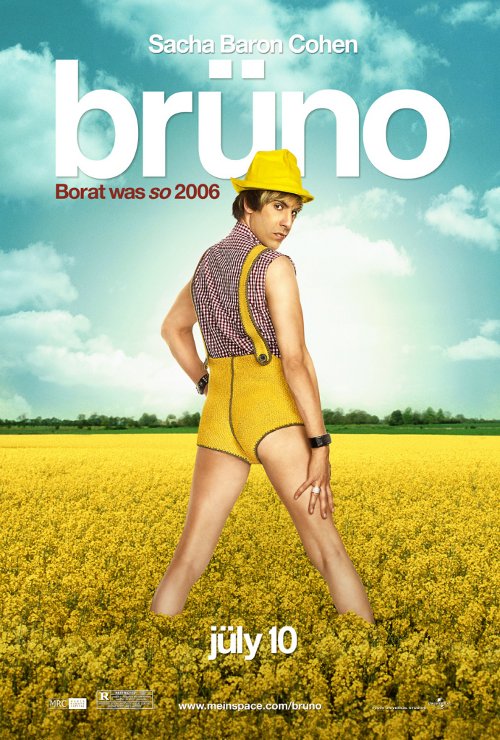
America, Say Hello to Bruno
The plot is pretty straightforward. Bruno, a flamboyantly gay fashionista from Austria, comes to America in hopes of becoming "the most famous gay Austrian entertainer since Arnold Schwarzenegger." In one of the film's most hilarious scenes, Bruno markets his television show to an unassuming focus group, and they are, to say the least, disgusted by what they see. In one of the film's raunchiest sequences, Bruno attends a swinger's party and walks around providing words of motivation, and asks if anyone wants a sandwich. You get the drift. The comedy in "Bruno" is strikingly similar to the comedy in "Borat", but so what? As long as Cohen continues to hit his targets with comic precision, his work will still come across as innovative.
Sacha Baron Cohen remains the most courageous man in show business, willing to place himself in the middle of seriously dangerous situations. If you think I'm exaggerating, wait until you see the scene in which Bruno sits by the campfire in the barren woods on a hunting trip with four homophobic men, with all four of the men looking as if they want to strangle him. Or the scene in which Sacha Baron Cohen, disguised as a wrestler, starts making love to his opponent in the ring, while the drunken, violent crowd throws chairs in his direction. Or the scene in which Bruno gets continually whipped by a dominatrix. The remarkable thing about Cohen is that he never loses character, not even in these scary situations. It's a magnificent performance of incredible consistency.
Many people will no doubt accuse "Bruno" of being homophobic, surely the same people who called "Borat" anti-Semitic, even though Sacha Baron Cohen is himself Jewish. What these people fail to realize is that the intent of "Borat" and "Bruno" is to denounce bigotry, not encourage it. By making Bruno such a flamboyantly gay character, and by pushing the limits of the R rating so strongly, "Bruno" tears the lid off what is considered socially acceptable, forcing even the most liberal, open-minded person to confront their own inner prejudices. Yes, "Bruno" is an outrageously funny, insanely ribald comedy. But most of all, "Bruno" is a call for tolerance.
Friday, July 10, 2009
Living the Gangster Life in the Public Eye
"Public Enemies" chronicles the life of 1930's gangster John Dillinger, one of the most fearless villains to have ever graced the silver screen. Say what you want about Dillinger, public enemy number one throughout the 1930's. But boy did he have guts. It wasn't uncommon for Dillinger, for example, to sit quietly and calmly in a packed movie theater while his mug shot is being shown on the movie screen and everyone in the crowd ordered to look around in search of America's most wanted man. It wasn't uncommon for Dillinger to casually take a stroll inside the Chicago police department headquarters, fraternizing with the cops around him. John Dillinger loved to flirt with danger. For Dillinger, robbing banks was a profession, and he proceeded in this profession with unflappable cool.
"Public Enemies", the latest film from director Michael Mann ("Heat"; "Collateral"), is an intensely fascinating study of this intensely fascinating man. "Public Enemies" does not attempt to explain John Dillinger; it simply tries to examine his life. The result is, for the most part, chillingly effective. This is due in large part to the first-rate acting from the two leads. Johnny Depp is brilliant in the lead role. His portrayal of Dillinger is an exercise in suave understatement, and Depp somehow manages to invoke emotion with a simple sly grin. Marion Cotillard, a spectacular beauty who won an Oscar two years ago for her breathtaking work in "La Vie en Rose", is stellar as Dillinger's emotionally conflicted lover. The scenes between Depp and Cotillard are the film's best. Chemistry is a tricky thing to achieve, but it is an easy thing to recognize, and Depp and Cotillard have a sizzling rapport.
"Public Enemies" is infused with Michael Mann's trademark style. Mann, whose "Heat" and "Collateral" are two of the most criminally underrated films of the last twenty-five years, perfectly captures the essence of 1930's Chicago. The film, shot with handheld cameras, has a visually alluring appeal that invites the viewer inside the dark and violent world of gangster life. Mann gives "Public Enemies' a documentary feel that creates an intimate connection between Dillinger and the audience.
With this being said, "Public Enemies" falls a little shy of greatness. With a bloated running time of 140 minutes, the film occasionally loses its' focus. Too much time is devoted to the other gangsters of the era, including Pretty Boy Floyd and Baby Face Nelson. "Public Enemies" would have been better served if John Dillinger was the sole focus of the movie. But these are minor quibbles in a movie that is ultimately richly satisfying. I walked out of the theater amazed at the sheer audacity of public enemy number one, John Dillinger.
Tuesday, June 23, 2009
An Ordinary Man Carrying the Burden of Human Life
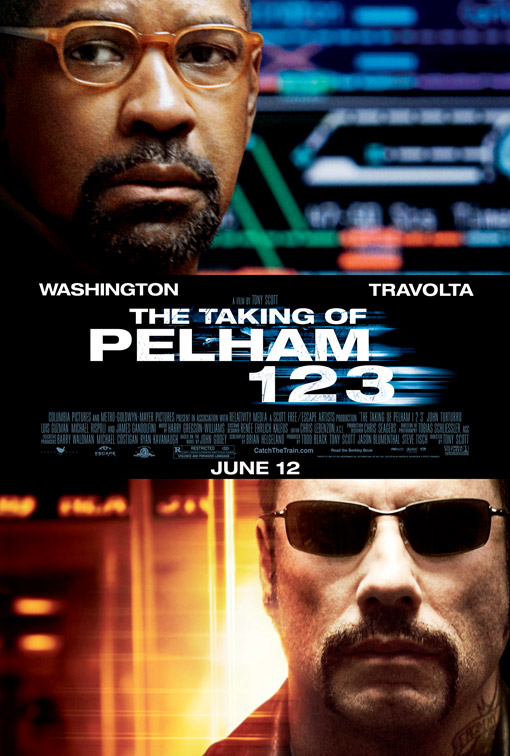
Walter Garber is a decent, good-hearted, flawed individual. As an MTA dispatcher, he toils away in a daily routine that lacks glitz and glamour. There is nothing extraordinary about Walter Garber's life. When he arrives at work on a seemingly typical New York City day, however, he is put in an extraordinary situation. A group of aggravated men have hijacked a subway, holding the passengers on the train hostage. The leader of the hijackers, a man who goes mysteriously by the name of Ryder, demands to talk to Walter Garber. Ryder wants no hostage negotiator or policeman; he simply wants to communicate solely with Mr. Garber. Ryder tells Garber that he wants $10 million in his hands in one hour. If the money does not arrive by the designated time, hostages will be killed. Thus, the burden of preserving human life is placed on the shoulders of Walter Garber. It is Garber's job to guard against disaster.
This is the premise of Tony Scott's "The Taking of Pelham 1 2 3", an update of the 1974 film by the same name. "The Taking of Pelham 1 2 3" is a satisfying thriller that provides moments of genuine suspense. The acting is first-rate, and the screenplay by Brian Helgeland ("L.A. Confidential"; "Mystic River") is taut and intelligent. However, while I do recommend this film, the shaky direction of Tony Scott is almost enough of a distraction to cause me to rescind my recommendation. Tony Scott is known for his hectic, dizzying style behind the camera, and his trickery has worked well before in "Enemy of the State", "Man on Fire", and "Domino". The heedless personality of those films warranted Scott's reckless energy. "The Taking of Pelham 1 2 3", on the other hand, does not require such gimmickry.
At its core, "The Taking of Pelham 1 2 3" is a character study of a working class man struggling to prevent tragedy. This material deserves a measured director, one who places all the focus on the story. Yet Tony Scott, for some mystifying reason, finds it necessary to bombard the screen with a myriad of nearly incomprehensible images. The camera shakes so frequently, it can be difficult for the viewer to form any kind of an emotional attachment with the film. The result of Tony Scott's direction is almost catastrophic. Fortunately, the strong acting, and one brilliant performance in particular, is enough to salvage the movie.
John Travolta is one of the nicest men around, but he makes for a convincing villain here. Travolta's character oozes insanity and insecurity, and Travolta gives a performance that perfectly captures the essence of his character's twisted psychosis. The supporting work is extremely effective as well. The always reliable John Turturro and James Gandolfini shine in supporting roles that are crucial to the success of the picture. However, there is one performance that makes this movie, and that performance belongs to the great Denzel Washington. Washington is spectacular as Walter Garber, and he creates a character on a completely human level to whom we can all relate. The audience forms an emotional bond with Walter Garber, and this is all due to the superb work of Mr. Washington. For Denzel Washington, "The Taking of Pelham 1 2 3" is a minor entry in a long and accomplished filmography, but Washington reminds us once again why he is one of the finest actors in the world.
I recommend "The Taking of Pelham 1 2 3", for there is simply too much skill on display for me to do otherwise. But this premise has the potential of greatness, potential that is not fully realized by director Tony Scott. Scott is a talented filmmaker who has impressed me with his skill behind the camera numerous times in the past. After viewing this film, though, I hope he learns a valuable lesson. Sometimes it's best to just let the story do all the talking.
Sunday, June 21, 2009
The Bachelor Party From Hell in the Sin City
At the movies, there is no such thing as a tame bachelor party. "The Hangover", the latest film from director Todd Phillips ("Old School"; "Starsky & Hutch"), takes us on a familiar journey through the aftermath of a hellish bachelor party. The premise is simple and not especially novel: Four guys go on a quick excursion to Vegas on the eve of the wedding, hoping to have a little fun before the groom commences married life. There is Doug (Justin Bartha), the groom-to-be, Phil (Bradley Cooper), a thirtysomething school teacher bored with his daily routine, Stu (Ed Helms), a dentist whose every move is scrutinized by his uptight girlfriend, and Allen (Zach Galifianakis), Doug's socially awkward future brother-in-law. The four men go to Vegas and purchase the $4, 200 villa suite at Caesar's Palace. Flash forward to the next morning and the suite is trashed. There is a tiger in the bathroom, a baby in the closet, and a bed on the roof. Phil, Stu, and Allen awake in a complete state of confusion, unable to recall the events of the previous night, unable to find the groom. They spend the day trying to find Doug, and this search is filled with a cavalcade of drugs, sex, and violence. Yup, it's a typical bachelor party at the movies.
"The Hangover" is an exercise in extreme vulgarity. The humor is hit and miss. When the jokes hit their target, "The Hangover" provides some very big laughs. When they miss, the result is simply cringe-inducing. The film is at its best when it mines humor from the personalities of the characters. When the movie aims for mere shock value, however, the jokes fall flat. For example, the situation involving Allen taking care of a baby is funny because of Allen's clueless nature, while the sight gag of an old man's naked bottom is simply unnecessary. Fortunately, "The Hangover" is more hit than miss, and the rapport of the actors is enough to mask most of the film's flaws.
Bradley Cooper is an actor who has always been underutilized, but "The Hangover" provides him with a vehicle to showcase his talent. Cooper's character is not as inherently funny as Stu and Allen, but Cooper keeps things rolling. He runs the show, and the film wouldn't work without Bradley Cooper's charm. Ed Helms, a consistently funny actor and comedian whose credits include TV's "The Daily Show" and "The Office", is hilarious, perfectly capturing the essence of a guy who is a little hesitant to go along for the ride. Zach Galifianakis is the film's go-to guy for laughs, and Galifianakis delivers every step of the way. His work here should serve as a career breakthrough. The only cast member who gets the short end of the stick is Justin Bartha, whose role as the groom is a somewhat thankless one. Cooper, Helms, and Galifianakis have perect chemistry, and they manage to make an absolutely ridiculous premise slightly believable. Emphasis on slightly.
In the career of director Todd Phillips, "The Hangover" ranks somewhere in the middle. This film is not quite as funny as "Old School" and "Starsky and Hutch", but it is infinitely better than "Road Trip". As far as raunchy comedies are concerned, "The Hangover" is a step below "Superbad", "Knocked Up", and "Forgetting Sarah Marshall". Still, 'The Hangover" is rollicking fun, taking the audience on an entertaining ride that keeps getting crazier.
Welcome to My Cinematic Paradise
Hello blogosphere and welcome to my cinematic paradise. This blog will be all about the movies, with exclusive reviews, essays, and thoughts on the movie industry. Before we get this blog started, let me tell you a little bit about my love for the movies.
I love the way that movies can provide a much-needed escape in times of trauma and turmoil. I love the way that movies invite us into a whole different world. I love the way that movies introduce us to characters that are larger than life. I love the way that movies force audiences to confront challenging issues of grave importance. I love the way that movies make us dream. I love movies because they provide a channel through which the geniuses of film can communicate with with the audience. Only at the movies can we witness the works of Scorsese, Eastwood, Coppola, Allen, Lumet, and Spielberg. I just love the movies, and in this blog I hope to share my passion for cinema. Readers may often disagree with my opinions, but it is my hope that even when they disagree they will be able to sense my love for cinema.